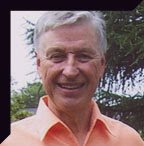
Each year in Kenya, I room with another happy bachelor (temporarily so and not by desire), Reverend George Mitchell, PhD. Many a Baptist Union church he has served in Scotland over the decades and is a man of God whom to know is to love.
One token of his esteem is that he does over 60 funerals a year. You see, George grew up with the toughs of Glasgow and he loves the common man and they turn to him, especially if they have not been the church-going type. They know he understands the edgier side of life and can speak fearlessly yet with compassion to those who have post their way and need a Pilot of the Soul. And we all know Who that is.
We love him here at Scott Theological College. He is a silver-tongued smithy of words, often now enhanced by power point slides. He writes booklets that he sells to a small market of those he comes in contact with wherever he goes.
But the most endearing thing about George—did I mention also that he plays a respectable trumpet and has a fine voice—is that he does works of compassion all the time. It’s in his blood.
As he goes about Scotland, where he is a popular speaker, he advocates for the poor in Kenya. And people give him money and clothing to stuff in his bags and wallet for the needy when he comes each January.
Not that he’s perfect. Without his wife, Jean, he’d be at sixes and sevens most of the time. I know, I live with guy for three weeks every other year.
But he has a wonderful sense of humor and can tell stories without taking a breath for hours on end. It’s a fine tonic just to pal around with him.
Here’s what he did the last few days of this week.
He went off with Vundi to talk to the leaders of a local Anglican diocese about the biblical work ethic. You see people here just pray for rain when they can be developing local irrigation that could lessen starvation. At the end of his seminar he hands over 250,000 Ksh for an agricultural project Dr, Vundi is spear-heading to help the rural folk grow more food. George has touted this when people back home want to reward George for his ministry to them.
George goes down to visit the gatemen morning and often evening. His has a bag. Take some socks – or maybe a shirt. Here’s a bit o’dosh for you. “O thank you—I’ll be buying food with it today for my family.”
He goes out to the town football pitch (soccer field) to meet the coach and cheer the local kids. “Could you use some uniforms?” So he goes with the coach downtown and buys shirts, shorts, socks in bright colors like that of the Brazil team. “Now could you cut and collect some of the grass here to improve your field and feed some cows the college keeps?” “O sure, Dr. Mitchell, we’ll do just that.” Their eyes are big. They never dreamed they could have uniforms! “You look like Brazil now,” says George, “go play like them then!”
George has bags of ties and scarves to sprinkle about among the students and faculty and staff here. And some shirts and pencils, and dresses and even a suit or two. Whatever he can gather from folk or buy in the thrift.
Each afternoon a tap on the door signals the kids have come looking for a balloon from George’s pocket. “What do you say?” he asks with a broad grin. “Thank you!” they whisper.
Here is a man who teaches Hebrew and Greek, New Testament and numerous other courses in a college in Glasgow, now retired, who knows from his youth what it is to want and is doing all he can about it for others in need. He’s not wealthy himself. But people trust him to deliver the goods to the poorest of the poor as well as to needs of all kinds.
There’s a story about a guy in Wisconsin who was a fabulous fisherman. When others were skunked he always came home with something—every time. The local game warden asked how he did it. “Come on out with me and I’ll show you.” So on a day they put out into the middle of the little lake and let down the anchor. The man pulls out a stick of dynamite, lights it, and hands it toward his companion. "Toss it out and start fishing." “You can’t do that! The warden screams. Fishing by stunning them is against the law!!!” “Look,” says the other, still holding out the sizzling TNT, “are you going talk or fish?”
George is guy who is always fishing. He is a wonderful talker you can listen to all day. But he walks the walk. For Jesus. For the least of these…. For those who are easily invisible as they stand to the side in the shadow while we fly along by on our important errands.
You will be fishers of men, Someone once promised. Are we talking? Or are we fishing? He’s holding out the sizzling stick to you and to me.
Wednesday, January 14, 2009

Monday, January 12, 2009
The Way Sunday Should Be
An inauspicious start. I am to go out to a village church to preach and teach today – Sunday. I did not bother to look in my date book because I was sure the time was 7:30 AM. At 7 Benson Gitchui and a student of mine (also Benson) drive up. I am still having some breakfast. Thankfully George invites them in for a cup of coffee. That gives me 10 minutes to finish, put on my tie and jacket, grab my study Bible and jump into the car. I excuse myself by thinking this is Africa not Germany—where everything has to be PRECISE! (And don’t mention The War!)
Benson knows this southbound section of the Nairobi-Mombasa Road. Where it is finished off he goes 70 mph; where the road is still the gravel washboard he can average a skillful 15 mph. A tank truck is creeping along watering down the choking dust.
In a half hour we are turning off the highway and onto dirt tracks. Everything is super dry, so we’ll not be sliding around on the turns or wallow in mud at the creeks.
We wind up and down, surrounded by dry farming shambas. The maize is knee high and ready to tassle out. But if they do not get rain soon all will be lost. The papers here warn of starvation for up to several million Kenyans. The price of grain is shooting up while people have little income to buy it. Businessmen are accused, in some cases, of profiteering. It is a dire mess! And the papers say wealthy countries are leasing land in these poor countries to raise food to be exported home. South Korea is in Madagascar. Ukraine is going to lease out a million acres or so. The new colonialism some are calling it.
Soon we are at the church—a plain rectangular building with a metal roof with a bit of colored glass in the windows. Benches and chairs, a few platform chairs, a table or two at the front. Can seat, I would guess, 250 Kenya style.
Joshua’s wife, Josephine, greets us and her girls serve us rolled chapattis and tea.
The pastor’s house is modest, with a kitchen, living room, and four bedrooms, one of which they use for storage. Did you know that a typical kitchen up here in the rural hills has nothing in it save for maybe a chair. There is no electricity here. Food is prepared on the floor using bowls and some pots—not much different than we would use if stopping on a wilderness trail somewhere to bed down and fix a bit of grub.
Joshua tells me that his wife (I had to ask him if she had a name) was also pastoring a small church in Salama. She has to walk for one hour over the hills to this town and then back after the service. Salama means peace and is home to a Muslim community with a small mosque at the center of the shops along the road. From Salama we later will see the Mukaa orphan home on the distant hilltop.
“We have time to see the river,” Joshua tells me. It is about a ten-minute walk. Sounds good to me. A little stroll before we sit for hours in the coming service—nice. It is sunny and warm, but not hot. Off we go.
We greet parishioners—"chuch membahs"—as we go. They are in their yard having breakfast before heading for church.
The rolling expanse of hills would normally be lush green this time of year. But dryness makes it all pastel. It’s not severe yet. So we are praying for some rains to come soon.
It’s downhill on a small road where goats nibble on hedges and plots are lined with sisal plants. That is the common boundary marker surveyors look for. If one tries to move the boundary (as is stealing land) the roots persist for a dozen years and the surveyors will go by that to settle boundary disputes.
At the bottom of the valley we see a dam about 30 feet across, built by “Wilson,” the white man who bought several thousand acres here a century ago. This impounded water and got the people through the droughts. Today there is a tiny trickle coming through the pipe. Below are huge boulders giving way to a pool of greenish water. A boy about 8 years of age is there. When he sees us he strips off his shirt—maybe hoping we will want him to show his prowess. I notice his green shorts have holes worn through the two back pockets and about ready to fail altogether. You see quite a few people with clothes just a thread away from rags.
Joshua shows us the shrine where tribals still offer sacrifices in times of drought. Like, I mean, animals. And the sand that keeps washing down from the hills is there for the taking. But you will suffer if you sell it for money—or even think of selling it.
Along the highway, Benson Gichui had said that there was a sacred tree right where the road had to go. But the tribals would riot it was touched. They found a creative solution. Someone went to the tribals and said that he heard the tree talking—in many languages, not just Kikamba—even the American language and that this would bring havoc to the tribe. Thus sowing fear in their minds, they agreed that this tree was a threat now and would have to be destroyed. So the road crew cut it down. You can see the trunk bulldozed off to the side of the road. Like Dagon headless in the temple of the Philistines.
Back to the watering hole. Goats are coming down to slake their thirst. Wild animals come at night. Joshua urges me to look down a narrow cut in the rocks. No water is seen below. But it is there. He says that boys will jump between these narrow rocks and fall nearly 40 feet into the darkness where the water is and then find a way to clamber out at the lower level. Very dangerous. The fathers warn their boys never to go near this place. Too dangerous! They know, because they jumped into the blackness when they were boys.
Now it is time to return. It’s all up hill. By now the sun is high. I have no hat, no sleeves to cover my arms. No water. The average Mzungu my age might have heat stroke or worse. I make it back and later lecture them that they need to think of what white-skinned people are facing so that they can provide what is needed to preclude problems. Yes—they admit. We should have thought of that. “Tell your wife (Josephine) and the ladies—they will remember!”
At 10:30 the service begins. 50 younger folk in deep blue shirts and black skirt or trousers start the slow shuffle, singing and motioning to the rhythms. I like it! They fill 5 files of about 12 people in front of the platform. They choir director is playing tapes with 3 live bass players and a keyboard guy. Electricity comes from a small generator down the hill snaking a 50 foot extension cord. Prayer by a layman lasts 10 minutes with most of the congregation standing before the Lord. Announcements. Offering. Songs by a trio of teen girls. A song by the ladies’ choir. This is GREAT! I notice the distant clock says 11:45. Then 12:15. I am introduced and start preaching after 12:30. “How long do I have?” I ask. “As long as you need.” O—this is a preacher’s heaven!
I choose the same text as in chapel at Scott: Deuteronomy 34 – Moses’ last hike up Mount Nebo. But since I have several Scott people here I cannot just repeat the message. So we talk about age of those God uses. Moses in 120 when he finishes his work gathering a throng of ex-slaves into a people. St. Paul was mid-sixties when he finishes his assignment upon a cross in seven-hilled Rome. And Jesus was half that age when he accomplished the redemption of the world on the hill of Calvary. Age and length of service mean little. Being faithful to God’s call is everything.
It’s starting toward one o’clock now. The men and boys exit so the women and girls can have their Sunday School time. We assemble under the sparse shade of an acacia tree. I request to face away from the sun in the best shade they, remembering Dr. Goldberg’s warnings about skin damage. What to say with little warning? Ephesians 5 on husbands loving their wives; children honoring parents. It’s all about giving, not getting. I pause for questions. You can tell they are not used to this. Finally a white whiskered Mzee asks what he can do for grandkids who are far from God now. At the end of the day he would come to thank me and we posed for a photo. Precious.
A man about 30 asks what he can say to people when all think they have the truth and do not need to come through Jesus. All the religions and philosophies of the world insist that one come and serve their god first and then maybe Allah or the spirits or the ancestors will do good to you in return. But our God stands alone in serving us unconditionally by doing everything for us first—including dying for us. Then He invites us to come and surrender our lives to His kingdom. Our God makes the first move and gives us the gift of faith so that we can come to him. This makes Christianity not a religion so much as a relationship. This is foreign to Islam and every other religion.
Now it is time to back to the building as the ladies are now finishing. As they adults and wee ones leave about 70 youths fill the front benches. What can I say to them? I start with a verse from Timothy and improvise from there. They actually listen! One 16 year old asks a question. Ten another question.
By now it’s after 2 PM. We are done. Now that’s doing church!
By three we are eating a meal with the elders at the pastor’s house next to the church. Chicken as tough as gristle in a thin soup. Chapattis, of course. Rice, Sukuma Weekie—a dish of cooked greens that has sustained poor people for months when there is nothing else to eat. It’s name derives from “that’s what you make do with the rest of the week when the good food is gone.”
As we leave pastor Joshua has us pick up Josephine and their two kids to make a brief side-trip to an acre of land he bought a few years ago and is having a stone house built. But prices go up while money goes down. So it is just shy of the roof and interior finish. When they can move in, he can drive to his church and drop her off in Salama, saving her two hours of “footing.” Churches are proliferating in Kenya. Joshua will get land to start another congregation to accommodate another several hundred people closer to their houses and shambas (small plot farming). Scholars call this explosion of the Gospel the emerging Southern Church—in Asia, Africa, and Latin America. It’s a pleasure to see a bit of it with my own eyes.
Back to Scott. It’s 6 PM That’s a typical Sunday for folk here. I admit I am tired. Who was it said, “my feets is tired but my soul is rested?”
I am late for supper at Shadrack and Milcah’s place with colleagues George and Nancy. They ask about Ellie and the Drapers. Personal ties with people 10,000 miles apart, yet one in our Lord Jesus, the Messiah, who came for us when we were all dead in our sins and without God, without hope in the world.
Now we walk in the light as He is in the light and have fellowship one with another.
Sunday, January 11, 2009
She was beautiful, spots and all,
Today was Saturday, our day of rest. Just a few quizzes to grade and then the faculty could go play. And play we did. You see, on Sunday is out to the churches to preach and mix with the rural folk. Stressful for a outsider. But that’s tomorrow….
At a ranch even bigger than the Bush ranch in Crawford, TX.
23,000 Acacia Acres. About 15 miles north of Scott. But with the washboard they use for a road it takes 55 minutes to get there. It’s typical African plains, with sparse groves of acacia. Did you know there are scores of varieties of acacia trees? Neither did I.
Three of us went early for a guided wildlife tour with a trained guide (all for $15 each). We saw the usual—giraffes, wart hogs, eland, Oryx (not common elsewhere), zebra, wildebeest, tawny eagle, lilac-breasted roller, and various antelope species, to name a few. And the rare Geranock (Sp?) Looks like a short-necked giraffe. We were in an open top land rover so we could get photos without shooting through glass. It was a warm day with a gentle breeze—no clouds.
But the highlight was my cheetah. You will see me with her in a photo when I get a chance to download my camera.
She was beautiful, though a tad overweight for a cheetah. Most cheetahs are bone-showing thin because hyenas hang out near them. When they make a kill they have to pause to catch their breath and the cheeky hyenas snatch the prey. But my cheetah was orphaned at age 3 in Somalia and ended up here on this Kenya ranch, fed on beef once a day, and kept in a compound at night. She may live to be 25—ten years more than in the wild.
Soon the guys say to save our photos until she comes out. One puts a collar around her neck—but no leash. “We don’t need a leash. If she wanders off we track her with the radio. But usually she stays close by. Just don’t make any sudden motions."
Out she comes. She sniffs us. First Jack and Karen Mitchell. Then me. Really glad I shaved and washed up this morning. She goes to lie in the shade of a thatched shed. We go up one by one to bend down and groom her coat with a brush the handler hands us. Photos are snapping. I am last. And—are you ready for this?—she licks my hand! Maybe she senses we are the same age for our species.
You can feel her black spots. The fur is different somehow. She yawns. Look at those fangs! And did you know cheetahs do not have retractable claws as most cats do? Neither did I. She lies back on her side. Stretches. I guess she is getting bored, for she ambles a few yards to sit on a mound to look out over the plains. I notice she is looking northeast—in the direction of Somalia, her homeland.
The guide now bids us come into a rickety barn that has been there forever. It has some thatch, some tin roofing. Unbelievable. It's got dozens of antique cars and cycles. A bit dusty, sure. But there is a Rolls, a T-bird, a hand-crank 1920s Ford. And that cream colored one? That’s the one Meryl Streep rode in while filming “Out of Africa,” the story of Karen Blixen. Motorcycles going back to the thirties. A couple of creaky bicycles, too. And the walls have wood shelves holding all manner of ancient auto parts. All out here on the plains of Africa miles from any decent density of population to enjoy these treasures.
I turn to go back toward the entry. And who is walking at my side? Ms Cheetah, of course. I think she likes me. That’s understandable. I tell her she’s the only cheetah for me. I don’t want her howling to the full moon next week about my cheetin’ hart. Maybe she mistakes me for a hartebeest. I have a hard time reading the minds of females of all species. I’m thinking of adapting an old Swedish song—“cheetah, my hand-lickin’ sweetheart—I’m crazy nuts about you!”
Meanwhile, back at the ranch, a lunch awaits us.
Wives and kids have arrived for a buffet under a thatched roof pavilion. All food guaranteed safe for western stomachs. A garden salad, spinach quiche, and cold cooked asparagus spears. Course One.
Go back to the hot table. Mixed vegetables, roasted potatoes, and breaded fish. Course Two.
Then to the custom-order chefs. They hold a 10 inch black skillet. Pour in oil. Add what you like. I choose onion, mushrooms, sun-dried tomatoes, fresh diced tomatoes, chopped garlic, braised Hamburg, green peppers. He mixes it over the flame, adds spaghetti. Mmmmm. Course Three.
Course Four. Repeat Course Three, smaller portion.
Course Five. Repeat Course One, smaller portion.
Course Six. Repeat a tiny Course Two.
Since it is Jack Mitchell’s birthday (yesterday) we all get hot apple crisp with ice cream. Course Seven.
That’s the perfect number. I know when I have had enough. No over-eating for me, nossiree!
Disclosure—I did not eat again that day until Kim Okesson and little Anna came to our house with hot muffins at 8 PM. A little glass of milk with the two smallest muffins (George is out so I ate one of his while it was hot, as I’m sure he would want) and I am ready for bed and sweet dreams.
Anyway—we talked out there while the kids chased Frisbees and watched monkeys. I dozed off quite a few times. A professor’s lot is not an easy one! We took a photo of the seven of us who are Wheaton College grads. Then over the washboard home. I managed four catnaps during the ride home, too.
Sweet dreams for me tonight.
She was beautiful—spots and all.
Friday, January 09, 2009
In the family way
It is well-known that Kenyans are into family in a big way.
Kenya has one of the highest birth rates in the world. Children are good gifts of God. More is better.
The back drop for this is a cultural history in which old folks are supported by their kids. So a bigger 401K is better than a small one.
This norm is changing now due to westernization. It may not be good, but the developing nations of the world are copying the rich and powerful nations.
I’ve seen this in small ways myself. When I first came here in 1992 women all wore skirts and dresses. Now in the big cities you see more western outfits. Technology is all imported. Computers are now commonplace in schools like this. Everyone has cell phones.
So rural bush life, while still the norm for millions of people, is shrinking like the glaciers on Mt. Kenya. So the birth rate shrinks for urban people who don’t need a quiverful of kids to support them in their dotage. And while all matters having to do with intimate relations is hush-hush, that too is beginning to change.
Since sister Lois Draper and Bob served here as teachers (Ukamba Bible College) twenty-five years ago, our extended family has adopted a Kenyan family that was living hand-to-mouth just a step away from a thatched roof hut.
I united Peter and Gladys in marriage here in 1993, standing under some trees in a local park. In 1984 Peter had been a teenager who came looking for work to help his widowed mother and four siblings survive grinding poverty. They were living in a couple of mud sheds like you might have in your backyard for garden tools.
A few weeks ago Peter and Gladys saw their 5th child—a boy—added to their family. Their first-born was named after me, giving me special obligations to the family welfare. But modern values are coming to the fore now, as they ask us how to help them ensure that this boy is the last-born. This may seem obvious to us, but it signals a huge shift in mindset for a Kenyan couple.
This is the family that received my big ugly red suitcase I mentioned in the first blog. Paul Mbandi, now the dean here at Scott, met Peter in Nairobi yesterday to transfer this and some cash to Peter.
Peter phoned my hosts here three times wanting to speak to me. After classes were done for the day, I managed to get back to him. He spent five minutes expressing thanks for what we had done. He had called his sisters, who now are working in Nairobi where Peter does ministry, to come and share some of the blessings.
What was in the suitcase? An outfit for an infant boy. They had already dressed him in it to go for his first check-up at the clinic. It had a cuddly lion that Ellie found in Target a week ago. It had 50 T-shirts of adult sizes that said something about Methuen, MA. It had some socks and a pair of trousers and stuff that I would never wear again. To us it was nothing. To them, a treasure. Some of those T-shirts will go to the poor that make up Peter’s tiny congregation eking out a life on the edge of a big city. The rest will be on the backs of this large extended family, not merely a means of keeping warm but as a pledge that somebody cares about them. “A T-shirt given in the name of Christ will in no wise lose its reward.”
And Ellie had sent some money to get Gladys and the baby out jail—I mean hospital.
You see the family here has no assets. No cushion. They live as Jesus did, praying for daily bread.
When Gladys went into labor, they went to the hospital. Without money they were not about to let her into the “Inn.” You can’t blame them, really. How can you run a hospital in a big city where most people are on the edge economically? The government has no safety net for these indigents.
So Gladys sat in the lobby about to explode. Peter said he hung on like a bulldog for several hours (!) insisting they had to take his wife in, prepayment or no. Finally—like the unjust judge—they relented. She delivered a bouncing baby boy.
Getting in was tough. But how to get Gladys and the baby out? After more than a week of a mounting bill, the shillings Ellie sent for them got into Peter’s hands and he paid them off. They all went home rejoicing.
That’s how it goes for the marginal in Kenya.
Marginal? Actually Peter is better off than most. He has a university education and a seminary degree as well. He preaches with a simple loudspeaker wherever he can. He has a few dozen converts who are poorer than he. He and Gladys give out of their poverty to those in need. Some days they do not eat because someone else needed the food more-to end their days of hunger.
Sure the Kenyans often have their hands out. Sure they often make choices we think are a bit reckless. But they are dodging their way through life as best they can.
And these dear brothers and sisters pray for us because they hear that there are layoffs and bank failures shaking our way of life. They know what it’s like to face uncertainty. Yet our troubles are nothing compared to theirs. For us it’s a couple of lean years. For them it’s a permanent condition.
So Gladys will go to the family-planning clinic to make sure this does not happen again.
Yeah—right! Just like our politicians will make sure we don’t have another economic collapse.
For us as for our Kenyan family, the Lord and the family of God is the only sure foundation.
He sees the baggage when it falls and hears me when I call
Washboard done! Circling small airport parking pads for an opening, we find no room at this inn. I hop out and go to the entrance indicated. You see, I can’t go in by the regular entrance for I need to show my passport to get to the inner sanctum. I explain to the attendant, who pats me down manually since this is not a general public entrance with full service scanning—it’s for employees.
Someone directs me to BAGGAGE, where I approach a smartly uniformed young woman on duty behind the counter. “I am so sorry, but I have someone’s luggage that went with me all the way to Machakos last night. It belongs to David Dewese.” She lights up. This will get one item off her docket. “I will call him now so he knows it has come!” It’s barely 7AM But I know young David will not resent this call. “Please apologize for me,” I say, “for he is likely a brother in the Lord doing ministry here for two weeks.” From her smile and nod I can tell she is a Christian. She points to the area where lots of neglected luggage is strewn over a patch of red concrete floor. “Your bag is over there.”
I am so grateful to God when I hug tight this beat-up old friend that has shuttled my stuff into the belly of many a plane and doesn’t seem to resent those duct tape patches.
Now for George Mitchell. He made it! We see his wee bald head bobbing about near the carousel. He waits. People come out through customs in a steady stream. An hour later and George is still inside. We can see him now going to the BAGGAGE desk to file a claim for missing luggage.
He has a rare tale to tell when we start on the road home.
In Scotland this winter there has been a plague of flu so resistant to medicine that thousands are ill. The pilots for his flight couldn’t make their assignment. It took an hour or so to find replacements. So when the flight got to Amsterdam it was so late that George had to fly down the concourse mazes to catch the plane to Nairobi. He made it. But obviously the bags did not. Ole George had to make a second trip to the terminal a day later, but did retrieve his stuff—crammed with dresses and shirts and ties and balloons and pencils, etc. that folk back in Scotland donate for him to distribute to the poor here.
Next morning he is so happy that his joy awakens me. He has a change of clothes now! And his own toothbrush! So he is washing up whilst singing basso arias from Handel’s Messiah. “For He is like a refiner’s fire and shall shake the heavens and the earth…,” rolling along like a winter wren, singing the scriptures. It could be annoying. But somehow I find it beautiful.
If Jesus were here now He might tell the parable of the Lost Luggage. “Rejoice with me, I have found that which was lost!”
God has seen two of his sparrows falling to the ground without their proper underwear and sox. And from heaven He has heard their cry and seen to it that not a bag of lost luggage is neglected. I think He knows the number of suitcases that are circling the globe in these flying tubes we call jet planes. And we have our stuff.
All is well that ends well, they say.
Sometimes it’s just “All’s well that ends.”
Thursday, January 08, 2009
To good to be true
After a superfluity of hugs and handshakes at church this morning, I am ready to go on my 8th excursion to Scott Theological College in Machakos, Kenya. Ellie came with me in 2005 and it was a disater for her. So I left her weeping inconsolably at the door as Jim and Zach Herrick whisked me away to Boston. She makes a huge sacrifice, stoking two wood stoves to keep the frost off the windows in Haverhill while I head south of the equator where summer sends the mercury to 80 degrees each day. But her new book is getting good reviews, so she can think of that with satisfaction. (Go to www.eleanorgustafson.com to read all about it.)
NorthWest Airlines gets me in to Schiphol Airport in Amsterdam at 8:05 AM, so I have some time to wander about the terminal before emplaning for Nairobi. I ask where Starbucks is so I’ll know where to meet April on the return flight in 3 weeks. I didn’t see Starbucks with my own eyes, but the friendly espresso girls tell me the direction. I’ve no time to go that far in the great spidery arms that these airports are. But at least I know it’s there.
Maybe I’ll have an ice cream, meanwhile. Ah –no, maybe not. $4 per scoop. And they will not fool me again. Some years ago when Ellie and I were here to visit her cousin and family (stationed in Europe with the U.S. Army) we got ice cream in Amsterdam. I kid you not—the scoops were the size of melon balls—you know the kind you use to scoop out cantaloupes back in the fifties? My cone with two scoops was gone in two bites. About the same amount of ice cream I shamelessly lick off the bottom of a decent size ice cream bowl. Sure, the stuff here is Haagen Daz. No better quality anywhere. But I could hardly TASTE it, let alone enjoy a close-your-eyes-and-smile tryst with whatever flavor it was. So today I just nod and wink at the kiosk and keep on trolling my carryon behind me.
Ah! Check “USA Today” for football scores. Too bad about Tony Dungee’s Colts getting sliced out of the post-season in sudden death overtime. But that’s what makes sports so popular. Anything can happen.
It’s now 9:30 A.M. and the sun is just coming over the horizon here. Where am I, the North Pole? No wonder Europe has fallen from its place in the heavens. Think how depressing this would be, year after year. Light is good! Sunlight is better! Then I recall that I am at the same latitude as Labrador.
Snoozing a lot en route, the trip over the Saraha desert goes by quickly. At Jomo Kenyatta Airport in Kenya the flight is on time and I am soon in the Visa line. Been here, done this before. But are these Kenyans are s..l..o..w. The nationals clear their queue quickly so I am waved over. Pay my crisp 50 USD and I have only baggage to handle now. (BTW, fellow bachelor-for-3-weeks George Mitchell came only with British pounds this year and had to go to exchange to get dollars. This in Kenya a former British colony and part of the Commonwealth!)
I grab a trolley (free use here) and look for bags. I canna’ believe it! There’s my ugly-as-sin red bag with all the Methuen shirts Ed Platz donated already on the carousel. And my black case next to it. This is to good to be true! Usually I have to wait until the last for my bags—you know, first on last off. Someone is smiling on me this trip! I grab them both, get waived through bag inspection (sigh of relief—they won’t hassle me over the new camera going to Deborah Brown’s friend Dalmas).
Look around for a familiar face or at least a sign with “Gustafson” on it. Bingo! There is Douglas Kaloki, the Scott driver, with his brother. We are loaded up and on the road in minutes, heading to Machakos.
The road is unbelievably BAD. It’s being re-built, so 60% is base—no hot top. Wash-board city. Any blood clots lingering in my legs from 15 hours of sitting in the Airbus are being shaken and pulverized. Almost feels good—almost.
By 11 we are dragging my bags into the cottage here. It’s lovely at night. The black, black sky shows stars an arm length away. The big dipper is low in the sky as I am in the southern hemisphere now. God is too good.
Then it happened. A reality check BIG TIME (for me, anyway.) I open my black bag and find strange contents! O NO!!!!!!!!!!! I should have checked it. I have another’s bag and mine is back at the airport! Bonnell’s are still up. I check with them. They call the airport—no luck with their cell phone. Joseph Ndebe’s lights are on—we’ll go there. He tries the airport, since we now know the owner’s identity from his Bible. He’s from TN and is here for a few weeks working with Baptist youth in Nairobi. At least he is not off on a safari to the boonies!
I’ll go back with Kaloki at 5 AM as he goes to fetch George Mitchell coming from Scotland. But—can I sleep with this uncertainty? I had been reading in a devotional about trusting God always, even when worry is almost excusable. So I relax as best I can to get a few hours of napping before I’m off over the washboard again in quest of MY STUFF!
Will our hero’s luggage be waiting at the airport?
To be continued….
Saturday, November 15, 2008
Go West, Old Man, Go West
“Life’s a long journey in the same direction,” said some philosopher long ago. And for me, the direction is west.
I had preached my sermon at chapel the day I had to catch the train. I took a chance on “mountains”. I had already preached on Bones in the Bible, with some success according to feedback.
So I took as my text the last chapter of Deuteronomy. “Old Man Mose done gone up de mountin.’ His eye warn’t dim nor his strength abated. And dat is sumpin’ given he was 120 at the time.”
Nebo is almost 3000 feet above sea level, right smack dab in front of the lowest lake on earth—the Dead Sea. 100 miles north he could see a white patch—snow-covered Mt. Hermon over 9000 feet in elevation. But he could see Mount Tabor, too. He didn’t know it at the time, but that’s where he and Elijah would come back some 1400 years later to talk with Jesus before he started the last lap of his race with our race.
Moses saw Mount Moriah, where Abraham had won the test of faith when he raised the dreaded knife over Isaac, the son of promise. David would later take the citadel of the Jebusites there and make Jerusalem the forever capital of God’s earthly kingdom. And just outside that high place Moses had predicted that a greater prophet than he would come. That prophet would be the lamb that would, unlike Isaac, actually be slain for our redemption.
On the long lonely trek up the trail Moses must have mused on the promise that God would give Abraham a land, a seed, and a blessing for the world. The seed was now several million souls. They had done well on that part. But they possessed not a single acre of the land. Moses wanted at least to see it before he died. And God had said, OK.
So God took Moses and buried his body somewhere on Nebo—no one knows just where. I think Moses died content. And so may we if we trust God. You see, people don’t just croak like frogs. God sends for us—maybe with angels, I don’t know. But we don’t just die. It says, “precious on the sight of the Lord is the death of his saints.”
Meanwhile there’s work to be done. Moses perhaps sees the camp of the Israelite hordes a few miles from their first challenge. Jericho is the first walled city—the oldest one on earth. Ahead were lots of valleys to go through and battles to fight. But as for them, so for us, God is going before us. Since Jesus, the land cannot be the geography of Palestine—that’s way too small for the billions now in the kingdom. Jesus changed the kingdom to the places where God rules as king. And that is in the hearts of those who like Moses, leave the privilege and wealth of the world to seek for the city whose builder and maker is God. Hebrews 11 tells us what we are in for if we join the king. Really tough going. But worth every tear shed and drop of blood that we spill in solidarity with the tears, groans and blood of Jesus.
I had a good time preaching that one to those precious brothers and sisters who are going out to serve in India, come what may.
One of those is Ashish Kandelahar, whom I met five years ago. He wanted to go into the hills where Christ had never had a presence and start a church. He came to campus the day before I left and told of the school he has now with about 100 kids and several small house churches. Wow! His wife was a student of mine. Preema and Ashish have a year old girl and are just full of joy in the work far off in the primitive towns a six hour drive from the college. (Preema is no slouch either. She got one of the highest marks in all India after she finished New Theological College.)
I thought back on all these blessings as I took the 6-hour train ride through the darkness to Delhi. Upon arrival I wave off the red-turbaned porters eager to carry my luggage. I had no idea where to go if I had used their services. I am waiting for Premji to come into the coach to help with the bags. But he doesn’t come. I struggle to the platform and sit on a bench. It’s midnight. Thankfully there are a few souls nearby, as I have almost no money, no way to call the office, and the platform is not a friendly place to park for long. I keep telling myself he’s stuck in traffic. Every five minutes seems like a long time. I keep whistling in the dark, so to speak, to keep up courage. Half an hour later, sure enough, he shows up and we are soon in the little van and off to the airport.
I have five hours to wait. Not enough time to have gone for a room. So I snooze, do sudokos, and snack on some nuts and an apple I took along. I’m thinking lots of people would think me nuts, floating in a faraway land like that. But in due time I am on the flight. And—I got an upgrade! Whoo-hoo! One of those larger seats. And by the window. I found out that when you wander to that forward galley usually forbidden to us peons, they have juice and snacks and chips and real fresh fruit that you can just help yourself to! And I do. I never knew how well these wealthy travelers made out. I wonder what its like upstairs in First Class?
I’m by the window, too. I get to see the barren land of Pakistan, Afghanistan, and the other “stans.” I could see tiny squares on the dry hills that marked settlements—far from any roads it seems. Snow-capped ranges in the distance. Beautiful!
But what’s this? My seat mate is an Indian who works in London. He tells me he goes back for month each year to visit family. He thinks India is the most beautiful place on earth. I choose not to challenge that. However, he is antsy. Restless? Man—he was all over, hoggin’ the armrests. Jumping in my window seat went I went to the lavatory. O well—he was pleasant and I did doze off a dozen times for about ten minutes. After all, I had been up all night.
We flew over the Netherlands. It was fairly clear by then, with the morning sun slanting in under the clouds. We had early morning sun for 8 hours, the pace keeping the full moon on the horizon for hours as we chased it westward. I waved at granddaughter April Gustafson living now in Amsterdam. I doubt she noticed. But it was a nice gesture. I’m all for gestures!
And as I write this at Heathrow (London) I have been up nearly 40 hours with a flight across the ocean still ahead. I expect Ellie to be at Logan with chauffeur Jim Herrick. She never comes to see me off—only on return. As they say, absence makes the heart grow fonder. Wait ‘til I get home from my trip to Kenya next January. She’ll probably hire a brass band!
As I sign off the blogs for this excursion of four weeks, I thank all for their prayers and thoughts. My heart is full. God, as usual, does wonderful things that make it a joy to venture forth, doing a tiny bit in the sweeping events that will come to a crescendo when the King comes back.
So whether we die on Mt Nebo or whether God takes us from bed in old age, we are the Lord’s. Meanwhile—we have work to do, knowing that in the Lord our labor cannot be in vain.
Wednesday, November 12, 2008
In the Wilderness
Nearly four weeks of listening to Hindi and I think I am finally figuring out a tiny bit. Not only do I recognize “Yeshua” as Jesus, but I can pick out a word here and there and guess what the prayer or the conversation is about.
For example, in chapel today the congregation was invited to mention requests to add to the list given by the worship leader. I stood to ask prayer for friend Debbie in Virginia who is very ill and whose doctor has disappeared due perhaps to legal difficulties. As sister Hemlata took the cordless mic to offer the prayer, I could hear when she said “sister Debbie” and knew that my request was presented before God. It was no trick—she said “sister Debbie” even though she was praying in Hindi.
Getting home after chapel, I went up to the upper room to make my bed. Yes—even I have some admittedly minimal standards. Egad! An inch of water on the marble tile floor and the sound of H2O going down a drain. But obviously not all going down the drain. Throw rug saturated, bedroom filling up. Since a plastic supply pipe had burst downstairs just the other day I knew where to look. Sure enough. A hose busted open and hot water flooding. I turned the shutoff, found a broom and started sweeping out onto the balcony.
Soon I heard Uncle George downstairs and shouted to call the plumber guy. Meanwhile I shut off all the other lines in two other bathrooms before going downstairs. Here’s a maintenance guy now—plunger in hand. Uncle is talking to him about “pipe-kay” and “replace-kay” and “leak-kay.” Bingo! My Hindi just went from 5 words to at least 50. Never mind Rosetta Stone. Just take a word that is used for technology or education and add “kay.” I can now point to the ed building and say “class-kay” and the cook will know I can’t stop for lunch now because I have class. “Exam-kay” is the next word I’ll try out. That should strike fear into all hearts. It’s my way of combating that nasty put-down that goes like this.
“What do you call a person who can speak three languages?” Trilingual. “Two languages?” Bilingual. “One language?” American!
Now get set for a terrific segue.
In life our supply pipes can burst and leave us floundering in a flood or drained dry in a desert.
That’s what our chapel senior preached on today. She took her text from Luke 4—the wilderness experience of Jesus.
I don’t know how this well-worn text can keep bearing fruit. How many sermons have we heard on the temptation? How many have I preached? Quite a few.
She reminds us that if we follow Jesus we will have the wilderness experience. We will be in the desert and tested to the max. After all, our baptismal commitment will be tried just as Jesus’ was. There’s no other way to refine and deepen our faith in God.
Not by chance, it is the Holy Spirit who brings us into the wilderness, knowing full well that our Accuser will meet us there. We will suffer weakness due to hunger and thirst. Without testing our faith is shallow. James and the other apostles say the same thing many times. “Count it all joy when you come under trials.” Are you kidding? Does that make sense? No—unless you have decided to follow Jesus, expecting that the Holy Spirit is the One who leads you into all these unpleasant situations. Why is it so hard for me to learn this? Is it God’s will for you to be going through the wringer? Answer: absolutely yes. God has ordained it.
“Turn these stones God has thrown at you to something that will benefit you.” The Accuser of the brethren (and sistren) points at all these stones God puts in the path. It’s like hiking Mount Lafayette last spring. My old limbs were getting tired yet ahead of me were more ledges and piles of stones I had to negotiate. Ever feel like quitting? Sitting down in tears saying it’s too hard—I can’t go on? That’s life in this world for the Christian.
So Satan suggests we turn those stones into something better. You’re hungry for change. Take charge. You can avoid these cold stones that block your way. You can think of a way. Maybe it’s a relationship that won’t yield to your will. Maybe it’s opposition or some temptation you cannot overcome. It could be a lot of things that God has allowed into your life that is just too much. But Jesus says, “Let those stones remain stones. I’ll provide in God’s way for you. Don’t give up.”
Satan suggests that the world God once controlled is now his. “I’ll give to you, if….” Wouldn’t it be easier to accept that and go along to get along? Just bow to me and I’ll give you your share of the world’s rich treasure of power and pleasure. Just do it my way and you can do it your way. So much easier.
And the Accuser is not totally lying, either. It is easier. The way of the cross means suffering and loss of the most painful kind. But Jesus knows Satan is tempting us with a short-term relief that will be paid for in spades in the end. No—we’ll worship God though we are going through hell. Better to go through hell now than to be in hell forever.
Lastly Satan whispers for us to put God to the test. Put out a fleece. Do something drastic to see if God really cares about you. He’s got angels at his command. What good are angels if you don’t call for them? Force God’s hand. This is really a call for us to manipulate God. Make him show up for us when we think the time is right. Doesn’t work that way, says Jesus. The heroes of faith of old suffered long and hard but would not cave in. Hebrews 11 recounts their wilderness experience.
So Jesus won the victory in the desert place and went on to live an easy life. “Victory in Jesus!” Wrong!
Here’s the challenge that came to me.
Try to think of one period in the life of Jesus when things got better for him.
I come up blank. His holy life was wholly in one direction: bad to worse. No exception. Hated in his hometown. Pestered by people more interested in health and wealth through his miracles than in his call to repentance. (Make no mistake, we would have gotten tired of this Galilean preacher whose mantra was repent, repent, repent.) Misunderstood by his disciples, maligned by his colleagues. Even the triumphal entry was tinged with sadness because Jesus knew it was just euphoria of a fickle crowd looking for a Son of David who could knock off the Roman Goliath for them. Holy Week was one holy horror after another for Jesus.
And Satan keeps whispering, “Don’t you deserve better than this?” Come over to my side. Go get that divorce. Go for the money and ease. Give in to the lusts every person has—it’s just being human. The Accuser often uses modern counseling as a tool to pry us away. You have your needs. You deserve more. Take it into your hands—God will understand your disobedience. He’s forgiving, isn’t he? What’s one more going to hurt, when it can give you so much relief?”
I get to the bottom line. Am I going to follow Christ into and through this wilderness or am I going to climb out of this canyon where I am so thirsty and hungry and in pain and just relax in the Devil’s Playground?
The speaker asks us to close our eyes and think on all this. I decide I am going for the gold, with the strength God offers. I am going to follow him right down the trail of pain and deprivation and suffering and even death. He told me upfront it was going to be like this. It’s the only way there is—straight through the wilderness. Embracing the pain as he did. That’s what it means to take up the cross, to deny myself. The other way is to seek to save my own life. The result is to lose it.
I’m asking God to sustain me in the desert experience, trusting in what he deems best.
Tuesday, November 11, 2008
Does HQ Know What Going on Down Here?
Will someone please tell God?
I’m sitting once more in morning chapel, absorbing the quiet reverence the community here observes, wondering what the Lord will say through the next student preacher. I muse on how the disciples took Jesus aside once to give him some practical advice. I must confess I have been tempted to the same foolishness now and again. After all, does he really know what he's doing? Especially in areas where we think he might tweak his strategy a bit to the left or right? I cannot remember the specifics off the top of my head, but my impression was that Jesus did not take kindly to their counsel. Was that when he told Peter to stop being Satan’s mouthpiece?
Anyway, the preacher and translator take their places at the pulpit to call us to prayer and preparation for the Word. Yikes! They are both women! How can this be in a society where only high caste women count for much? She is dark-skinned—low caste.
Will someone please inform Headquarters? Women are supposed to be silent in church. And a preaching role for females is definitely contrary to proper theological grasp of the New Testament.
And look at the text she takes! It’s Hebrews 10:26-31. This is one of the most challenging passages for those of us who believe in the sovereignty of God in regard to salvation. People who truly know Christ are not supposed to fall away into divine retribution.
She probably has a weak grasp of the text, right?
Wrong! She is rattling off Hebrew and Greek terms in a way that indicates she has done her homework. She refers back to Hebrews 6—another troubling text for Calvinists like me. It tells of how those who are enlightened and have tasted the gift of salvation and the powers of the age to come cannot be brought back to repentance because they are crucifying the Lord all over again.
The text in Hebrews 10 only makes it worse. Those who make a conscious choice to keep on sinning (about salvation by Christ alone) put themselves under God’s judgment. It is well deserved because they trample the precious blood flowing from the cross. They bring upon themselves a “fearful expectation of judgment and the raging fire that will consume God’s enemies.”
She bids us to examine our hearts to see if we are just going on autopilot or are truly repentant for our sins and mistakes. God knows the heart. He is ready with mercy. But we must be sincere in our repentance.
She asks us to stand for the benediction and grasp our neighbor’s hand as we stand in the presence of the God who searches hearts.
Why does God pour out his power through such a humble and, some would say, unqualified vessel as T.G Pushpam?
Uncle tells me later that her dark skin tone signals her origin. She is a low caste—one of the many untouchable jatis in India. But God has gifted her. She will serve with Wycliffe translating the Bible into a language in the remote northern hills. India has over 400 languages!
One thing that brings tears to my eyes (as a far possible for a guy) is to see the interactions here. People are fellowshipping warmly together from groups that Indian society says should not be talking together, nor sitting together, nor eating together, nor worshiping together. The caste system is a pernicious curse. But here the curse has been broken. We are all the same before our God, who created of one blood all the ethnicities of the earth. If you want to see a miracle, this miracle of grace is huge. We are “one in the Spirit, we are one in the Lord.”
On second thought, do not alert HQ. Jesus knows what he is doing.
As I think about this college I shake my head in amazement. It is only twenty years old. But God has raised it up in a forbidding environment here in North India. Thirty full time faculty give second to none education in Bible, theology, music, missions, and culture.
Uncle George, the founder, stands amazed that a kid from a poor family in Kerala could be used for such a ministry. He gave his life to Lord at age 19 and was called from political ambition to ministry. Attending Fuller Theological Seminary in California, he became an officer in Ted Engstrom’s “World Vision” program, designed to help the orphans in Korea after the war there. World Vision has become one of the premier Christian relief ministries in the world.
But George Kuruvilla Chavanikamanil felt a call to return to India—to north India. He resigned his position and shared his call with some friends who soon formed a board to see what could be done.
As he traveled about looking for a place to start a training school, he and his nephew came to the Dehradun area. Land here—as in most of India—is very costly. India, as you know has about one billion souls on land about the size of a third of the USA.
As a fundraising tool one of the board members suggested making a model of the college they were dreaming of. He needed a sense of the “lay of the land.” We have no land as yet.
So he said he would pray that the Lord would help him think of something appropriate. This is where God shows up!
This man had never been to India. But he produced a model of a future campus. He placed it in a flat area with a small hill to the right of the proposed buildings. The hill had a series of terrace-like “steps” that made a height of land.
As George and his nephew Babu explored leads, his wife Leela was praying with church folk back in California that they would find five or more acres of land at half the going price, $25,000 the limit. But land here is more than that for a single acre. Nevertheless, they prayed.
The searchers at last came to Dehradun but nothing materialized. They were about to go elsewhere. They prayed, “Lord, you have to show us the way—we are out of options.”
That day they were told of a local man who had heard of their search for real estate. He sent word that he had a mango orchard off the Kulhan Road that he was willing to sell—the trees were dying and he could get no profit from that land. So George and Babu went out to look. It was nearly dark. They couldn’t really see anything. Unpromising. They went back to the hotel. Babu joked: Did you see any hill, Uncle?”
In the morning the two sensed that the Lord wanted them to go back and look one more time. As they came through the brush to the edge of the dry riverbed they could not believe their eyes. There was a terraced hill across the riverbed. George and Babu raced ahead of the others to stand on this hill and claim it as an answer to prayer. It was exactly as the architect 10,000 miles away had sculpted it on the model!
Price? “It is no good to me--$25,000 and its yours.”
This was the first of many unusual answers to prayer, resulting in a large campus training several hundred young people for evangelism and missions in a very hostile region of India. More of that another time.
I sense that I am living for these weeks on holy ground, the gift of a God who answers prayer in astounding ways.
And by the way—the mango trees all began to thrive once the deed was registered.
I think Headquarters knows what it is doing.
Monday, November 10, 2008
Of Oil and Water
You should hear the student preachers.
This morning another senior gave his 15-minute exhortation, taking as his text Psalm 133. Seemingly a ho-hum 70-word poem by King David. What can come out this, the last Song of Ascent? Sure—it’s about unity among the pilgrims coming from all corners of the land to the great festival in Jerusalem. But what can we squeeze from this old lemon that’s relevant to 21st century Christians?
The young man hinted at allegory. O my, thought I—not an auspicious start. But then he skillfully noted that this is a poem, a song, and should be understood accordingly. What does David intend by the poetic license he uses with these striking images of oil on the beard of the priest and dew on the snowy peaks of Syria? To us, oil is oil.
We know Bedouin tribes used oil to replenish parched skin—the ancient equivalent of Oil of Olay. So the image of it running down from head to beard to collar makes some sense. That’s the part exposed to the sun. Sort of like us in winter jumping into a cozy bubble bath after a day on the icy slopes.
But here the Bible scholar earns his keep. You see, the emulsion used was a special concoction of oil and spices from the secret recipe of God himself. It was not to be used except to anoint priests. Exodus 30 details the sacred formula: myrrh, cinnamon, cane, cassia to be blended in specific proportions by a perfumer to anoint the Tent of Meeting and its utensils, as well as the priests. It is not to be used for any other purpose. It is a Holy Blend. The harmony of God’s people is thus holy and unique in a world torn by divisions of nation, creed, caste, race, and language.
The dew of Hermon to the peoples of Palestine was a pure and perpetual source of life, feeding the streams that nourished the plains below. Mount Zion in Jerusalem to the south is arid in comparison. Mount Hermon is lofty; Zion is lowly. But the poet imagines the life-giving action of the perpetual moisture of Hermon falling on the people of God as they gather to worship. There the Lord commands life to flourish—life forevermore. In that life humans come together as one before the Living God.
Our preacher now sends the arrows to the mark—straight to our hearts. India is wracked with divisions hard for us in the USA to grasp. While we have discrimination lingering in the background, here it is in your face every day. Caste and color count for much here—it’s the curse of thousands of years of Hindu worldview. Poor and uneducated people have little hope of deliverance from their grinding condition. Gender bias is stronger here also. You see it everywhere—so obvious.
Sad to say, it is present in the churches, along with doctrinal divisions. This is not what God intends. By creation God made but one human distinction: man and woman. None besides. Yet we have a thousand divisions in society and even in the body of Christ. We must get rid of this ungodliness. The connection? The spices lose their individual identity as they meld into the fragrant composite. The two mountains become one in the single mountain range whence the life-giving waters flow, replenished from the dew that falls from the heavens.
The Duke of Wellington, a century or more ago, went to the altar in church to receive the sacrament of the Lord’s body and blood. He came down the west aisle and knelt down to receive the host. At the same time a poor peasant came down the east aisle and knelt. Someone touched the man and whispered for him to arise and wait until the Duke was served. But Wellington, grasping the intent of the touch and whisper, grabbed the man’s hand so he could not rise. “We are all equal here. Stay where you are.” His words carried to the congregation and thus are known to us.
As we rise for the benediction, he asks us to hug the person to our right and left while saying, we are one in the Lord. Now this may seem easy. But for some in this audience it may be a stretch to actually act out across a socially ingrained barrier to that degree. Sitting next to someone not your background and speaking to him or her is one thing. Touching them with an embrace of unity is another.
But the dew of Hermon was among us this morning. “How good and pleasant it is when brothers and sisters live together in unity!”
Sitting in the “seat of the skeptical”—the backbench faculty, I notice that even we hardened old warhorses are actually moved. Good preaching informs the mind of new things mined from the Word of God. But it must also move the heart and energize the will to reach for a new level with God.
Well done, senior preacher!
Sunday, November 09, 2008
Food for the Soul
Today is Sunday. Up early, shower, breakfast and I am waiting for Joel Joseph, a lecturer in Old Testament at New Theological College. He has invited me to go to his church beyond the southwest side of Dehradun at Jamunkhata. I have suit and tie and, most of all, my Bible—the big one that I could preach from for a lifetime if need be.
He comes 25 minutes late. He was trying to call me about the delay. I was out here enjoying the morning sun and waiting for you. No problem. “Oh, by the way, would you bring the message this morning?” Again—no problem.
You see I am experienced in these venues. I have learned, first in Romania then in Kenya that a pastor is expected to have something at his fingertips with no notice. That’s why I told Dale Brown, when he asked me how much warning I needed to fill the pulpit replied, “Fifteen seconds.” During the time it takes to walk up to the platform, I’ll have something come to mind.
As we wait for sister Debbie Sudheer (Professor of English) I begin to thumb through, coming across John 4—the woman at the well of Sychar. That will be good. On the hour ride (it’s 30 miles) I have time to jot a couple of notes on a bookmark.
At 8:45 AM the roads are sparsely dotted with walkers, bikes, scooters, cars and trucks. Surprising, since Hindus do not have a day for worship. It’s every man for himself, so to speak. Joel tells me most offices and all government installations are closed Sundays. I assume it’s a holdover from the British Raj of previous centuries.
We drive by the prestigious Military Academy, equivalent to West Point. The grounds are beautiful as I peer through the gates. Dehradun is also home to dozens of colleges and universities. Reminds me of Boston in that way.
Now the road is narrowing as we turn off to a side track. Fields of sugar cane. Mango groves. Here is the little church building on a tiny plot of land. Joel tells me that the owner of the rice fields and mango orchard to the rear is willing to sell as much land as the church wants. And they need land to move a small orphanage into the site as the building they rent further down in the town is having the rent doubled. The kids are distinguishing themselves in school exams, so there is demand for the school to grow. The new land here will be sold them at a discount. But it’s still about $50 grand an acre.
We park, slip off our shoes and go in. Two NTC grads (in the one-year ministry certificate program) have the place open already. He introduces me to one man who came out Hinduism and is an evangelist. Not by profession. He just helps people in need, prays with them. The locals respect him and he wins some to Christ. I sit up front on one of the few chairs. Around 10 people start to drift in. Singing and an opening prayer get us underway.
The men all sit on the left, women on the right. By 10:30 the young man with guitar is getting things going. Joel moves to the drum set. The volume rises, everyone clapping. There is a woman in front near the wall. Joel had told me she was a Hindu. When she converted, her husband kicked her out and her family shuns her. There is a movement going on as we speak in much of Hindu India protesting religious conversion. I guess there is freedom of religion as long as you don't change - stick with your heritage. This woman cannot carry a tune or stay on key. But there’s nothing wrong with her lungs. She is soaring off pitch to a crescendo of praise to Jesus. In a while she will be doing like jumping jacks and raising her hands. You can see Jesus is all she has. But obviously he is enough. The rest of the now 50-60 worshipers are really into it, too.
I cannot grasp a word, with the exception of "hallelujah." That word is the same everywhere in the world among Christians. But I am smiling with joy. How can you help it when you know the background of these people?
It’s after 11 now. Time for testimonies. One young woman mentioned Special Olympics and special needs as she rattled on. Some words are just grafted into a language from English. After the service she greeted me in English, so I asked her what her testimony was. She works with disadvantaged and handicapped children. She mentioned that she is praying for her Hindu family—she is the only Christian. So we paused and I prayed with her about that.
Joel told me later that another testimony was from a sharp guy about 35 who tries to help poor kids get an education. He was praising God because someone has donated a laptop to one boy, enabling him to get into a technical college.
Now it’s my turn. Joel interprets. I bring greetings from the family back home, our church, and all USA believers. Then into John 4, using one verse. (I have 30 minutes, but half of that will be Joel’s translation into Hindi.) Jesus said to the disciples, “I have food to eat you don’t know about.”
The upshot is that there are two groups Jesus is dealing with. The woman at the well, who has had a troubled life and is probably the target of gossip about town, on the one hand and the disciples—Jewish guys not at all comfortable going through this land of the heretics: Samaria. But the second class—the local people, get the blessing—coming to know that Jesus is the Messiah. The disciples are all hung up about food and why Jesus won’t eat, since they knew he was exhausted from the journey. Jesus has something that has suppressed his hunger and energized his weariness. He has gotten through the defenses of woman in need. He has the joy that comes when God turns on the light in a searching soul.
The more orthodox disciples just get annoyed about hanging around that place for another two days. So Jesus has crossed many barriers to reach us in India and the USA. We are now one in him. We belong to each other as we work for the kingdom until we sit around the table above celebrating the victory of our wonderful Savior.
This is so precious to me. The music was a bit loud for my ears. The floor was cold to my stocking feet. We were there going on three hours and I could grasp almost nothing. But I didn’t care. I was in a place where faith was real. I could feel the intensity of their attention. They wanted to thank Jesus and hear his word and pray for each other. Rough around the edges, yes. But perhaps as genuine as any worship on earth this Sunday in November.
After the congregation leaves, we go upstairs to the small apartment. There three guys have their base for ministry. Just a kitchen and couple of bedrooms. They are cooking rice—in an old-fashioned pressure cooker I haven’t seen since my childhood. A veggie sauce (dall), some chapattis, yogurt, and a plate of sliced red onions. Nice meal.
Joel asks me to pray before we go. This little congregation has already spawned several small daughter churches in the area. It’s hostile territory here. God seems to be ignoring that. PTL
So it’s back through the city. Lots of clogged roads now. Time to put a bag over mt head and just pray.
I think I understand what Jesus said in that text.
"I have food to eat that you do not know about"
Satisfied, though tired. A blessed place to be.
Friday, November 07, 2008
Grinning Like an Idiot
Why am I grinning like an idiot?
There is no reason for it. It’s sort of like when you get the giggles and can’t stop even though the stimulus is long past. Still—it’s a pleasant experience. As Norm Kuehne often says, it’s better than a kick in the head.
Maybe it’s the setting.
Today as I sit on the balcony upstairs in Uncle and Auntie’s house with the mountains of north India surrounding, the setting is about as perfect as it gets. Wall-to wall sunshine, hardly a whispering zephyr, temperature caressing me like a perfectly drawn bath. The college is off on a picnic miles away. No hubbub coming from the road up the hill with its hectic buzz of traffic and its construction sites. So I sit here with devotional book in hand (its has a gentle leather smell), looking at nothing in particular, and grinning from ear to ear—out loud, so to speak.
This is not me. My mind always races here and there like a squirrel on steroids. So to have my mind alert but calm is a treat. I can almost see the smile of God. Sense his nearness. God is my Father in heaven, my mighty protector and warrior king. But today I am just his friend. The kind of friend you often just sit with, looking into the fire or gazing at the clouds, not needing to say anything. Just being together, that’s all.
Maybe it’s the guy in me. You recall the story of two guys who spent the evening watching the game. The wife comes home from time spent with “the girls,” full of chatter and laughs. “Did you have a good time with Ned, dear?” Yup. “What did you do?” Nothing, really. “OK – talk about anything interesting?” Nope. We just sat and watched the game. “O, I’m sorry….” No—it’s OK—we had a great time!
So here I am smiling, having a great time. God isn’t saying much. I’m saying less. Great time. I can’t stop smiling out loud.
There’s a tree a few feet away and the balcony puts me about half way up. It is broad-leaved, but the branches come out in whorls like pine trees do. Half the leaves have dropped by now. Here comes a bird the size of a cardinal but grey with blue accents and a perky crest. Sits there in the sun just singing. Sparrows and a warbler like bird groom the twigs, while a squirrel splays himself head down on the trunk, soaking up the sun on his back. He is so well camouflaged you wouldn’t see him if he didn’t move. Seems like I’m just another creature motionless in the shade of the balcony. I am hardly breathing.
Here comes that idiotic smile again. Good thing no one is taping this.
A hundred meters away a score of boys is grooming a flat bit of ground—apparently for an alternate playing field. I can barely hear their quiet banter. A pair of girls walks off toward the chapel building, their saris adding a splash of color against the distant hills.
I’ve been here half and hour now—God and I—just being friends. There I am—grinning again!
I am feeling good, too. Rested. No aches and pains today anyway. I have no urgency, no deadline for the day. That helps. Even so, to be at ease like this is a rare gift. I’m not even worrying when it will leave me, though I know it will. Once again God will become my commander-in-chief and I’ll have to strap on the full armor and go off to battle. But that is not troubling me. It’s part of the rhythm of our life in Christ.
There goes another leaf spiraling to the ground below me. A big bee buzzes around my head—noisy little guy.
I pick up the red leather Guide to Prayer. Two quotes catch my eye. “It is so hard to be silent, silent with my mouth. But even more, silent with my heart. There is so much talking going on within me. It seems I am always involved in inner debates with myself, my friends, my enemies…, my colleagues and my rivals. You, O Lord, will give me all the attention I need if would simply stop talking and start listening to you.” Henri Nouwen in A Cry for Mercy.
“Jesus’ relationship to his disciples was that of friendship, chosen friends; he was rather critical of familial ties. His friendship transformed their lives….” Ann Carr.
Maybe that’s why I am smiling so unabashedly. He’s a friend.
Even after the resurrection Jesus took the stance of friend. Those two who were walking dejectedly on the road to Emmaus from Jerusalem, where all the horror had taken place, found a new friend walking along with them, talking current events and Scripture. The three decided to take a room at the inn and to have a meal together. No big deal. Happens all the time in our travels, doesn’t it?
But there was something strange yet familiar in this new friend. He was such an enlightening conversationalist. You just loved to exchange ideas with him. But what is it about him—so familiar yet not? Then he prays over the bread, over the wine. Bingo! He’s gone. The two stare at each other in stunned shock. Silent. Not a word passes between them. They just sit shaking their heads, grinning from ear to ear.
“So God imparts to human hearts the blessings of his heaven,” wrote Phillips Brooks.
Troubles of tsunami proportions lie ahead. But for this hour, this place—peace on earth, goodwill to the friends of God.
I’m still smiling ear to ear, grinning like an idiot, sitting on the balcony with our mutual Friend.
Simple Things
We are in chapel again. Our speaker is from Sri Lanka originally, But he was a student here in Dehradun many decades ago at Doon Bible College. Later he got a PhD from Fuller—as you may know the seminary home of Uncle George, our sainted founder, and of myself and many friends.
He took the mic in his hands so he could wander a bit as he spoke. He made some comments in sympathy with the students, recalling the 1000s of pages he had to read each 10-week trimester and the 20 page research papers, that sort of thing.
He lit a candle on the pulpit as an object lesson for his remarks on John the Baptist, likening our ministry to the wax (our gifts and talents given through the image of God in us), the stand (our character), and the flame that burns for the Lord (our passion for ministry lighted by our love for people.) Twice he had us doing hand gestures to underscore certain points about leadership in ministry.
He sprinkled in some jokes and used a light touch. Students were definitely with him and applauded after the benediction.
I saw something of myself there. And frankly I did not like what I saw.
What a contrast to the plain earnest proclamations of student preachers we have been sitting under these past days. No gimmicks, no cute stuff, no studied tugging on the audience. Just from the heart, in stilted English. No shooting from the lip. No trying to impress.
I know this man is a true servant with years of accomplishments here in India. But somehow God failed to move my heart. In fact, God told me quite plainly—you are that man in some respects. So my unease with him was in reality unease with myself. I can easily give a good sermon. But that does not mean I have been used of the Holy Spirit.
I am reminded of a parallel.
Leo Tolstoy, that superlative Russian novelist (War and Peace; Anna Karenina, etc.) remarked about the effect music had on him. He was a guest at a grand evening with the nobility. They had dined on the finest in a magnificent setting. A live chamber orchestra had performed the latest Beethoven masterpiece—brilliantly executed and applauded by all.
Traveling home by carriage, Tolstoy passed by peasants harvesting grain. As they bent their backs to their work they were singing a folk song to keep their rhythm. As the sun lowered in the west, soon to mark the end of another day, they sang their way through the hours, toiling by the sweat of their brows.
It struck the great author how moved he was by their simple melodies, hovering pure and clean in the hazy air, in contrast to the busy almost tortured cacophony of the great Ludwig van Beethoven, the toast of every European salon. He found in the peasant song authentic beauty and even truth that moved his soul towards them and towards God. Beethoven may have been an impressive showman of what man can do with sounds and rhythms. But something profound and even ethereal came to his heart through unaffected music, conveying emotions of universal brotherhood.
Tolstoy has a point. It came clear to me in contrasting the polished Fuller grad and the eager students. Some messages are powerful through cleverness; others through the Holy Spirit.
St. Paul, undoubtedly a gifted orator, bypassed his talent when he went to the great city of ancient Corinth. Here’s how he put it.
I resolved to know nothing while I was with you except Jesus Christ and him crucified. I came to you in weakness and fear, and with much trembling. My message and my preaching were not with wise and persuasive words, but with a demonstration of the Spirit’s power, so that your faith might not rest on men’s wisdom but on God’s power. I Corinthians 2:2-5
I had heard a well-executed message by a real pro, but left flat, and thinking in a way that I may have heard myself. Lord save us from our gifts and talents. God is working on me, and I am thankful.
Item: I am also thankful a safe return from a cycle excursion to Grace Academy.
As we were at morning tea, Shivraj offered to take me with him to fetch his 6 year old (I can tell cuz she has no front teeth) from school about noon. Otherwise she has to wait for the bus and get back at 3 PM. “You have a helmet?” I ask. “O Yes.”
So he comes on his Prisma to pick me up. “A helmet?” I ask. “We only need one for the driver as the law requires.” OoooooK.
“Hold these,” he says pulling four books wrapped for mailing out of the mesh on the back “seat.” So I hop on, holding the books in one hand and using my best knee grip from Ellie’s college horsemanship class of yore. Off we go.
Pretty tame, as top speed with me on back is 25 mph. We only had to lurch off pavement once to avoid a triple passing play on the opposite lane. I’m thinking, “If anything happens I know I’ll be a grease spot.”
“We’re going the back way to avoid traffic,” he shouts over his shoulder. Real nice drive on a posh private road, free of debris and smoldering trash piles. As we slow for the Speed Breaker (bump, to you) I can read the markers we pass every 100 yards. George Everest headquartered his survey work here in 1846, when he measured the highest of the Himalayas. Makes sense—Mount Everest. Another marker says something about 20 years of trigonometric measuring. He started at sea level a thousand miles south and triangulated from there.
Shivraj parks at the academy and disappears to find his little one. Other parents are picking up kids—all on scooters or bikes. One goes by with a pint-size kid clinging to Dad’s back like a monkey on its mother.
Here’s little Smriti now. “Say hello to Uncle.” “Hello Sweetie,” says I. She grins. He turns the bike around. Sweetie is on the gas tank in front of Shivraj, with her little backpack near the handlebars. I am on back once more, still clutching the books and the grip behind my seat. “Too much traffic to go downtown to mail the books. We’ll go back the same way we came.”
As we part, Shivraj asks if I would like to go again some day next week. Sure—why not?
Perhaps I should pray about it. Some of the weekend ministry teams were cancelled today. Hindu militants are now in this area—an incident a few miles away a few days ago. “Using wisdom”—that’s how the brass put it.
Thursday, November 06, 2008
Zelophehad's Daughters
I couldn’t believe it.
This morning in chapel the message is given by a senior student—part of the requirements for graduation. He announces his text from Numbers 27:1-11. It’s the account of the daughters of Zelophehad. How many sermons have we heard from this passage? For most of us—zero.
How is this going to propel him to the top of his class?
The hymn he chooses is “What a Friend We Have in Jesus.” Does he sense that’s about the only friend he will have at the end of his 30 minutes? And his prayer focuses on the comfort of the Holy Spirit for those most despised and rejected in society—soldiers, HIV/AIDS victims, homeless kids, widows, outcastes. I must say I am a bit nervous for him.
Then he begins to preach. Energy and passion. That’s as it always should be. Preaching is not a lecture on the Bible or its theology. There is a place for that, but not in the pulpit.
He lays the background by inviting us into the story. The congregation is no longer fidgeting. He is preaching as Jesus did—telling a story, a real life account, appealing to our imagination, painting a picture with words. The lessons will be embedded in real life rather than three abstract “points.”
The five daughters are descendants of Joseph, once the prime minister of the super-power of the day—Egypt. Their father has died without any male issue. And this is the basis of their rejection by the Israelites. You are somebody if you have an apportionment in the land about to be possessed. And that land is passed from father to son.
They come, in fear yet boldness as Esther would later do to her king, approaching the ageing Moses—a man not to be trifled with. Their case? “Our father died in the desert.” That means he voted No on the referendum about going up against the giants. He was no Joshua, no Caleb. But, to his credit, “he was not among Korah’s followers. He died in the desert for his own sin.” Korah’s clan had been cursed for open insurrection against Moses, and thus against Yahweh. Yet the people were rejecting these daughters as rebels who had no standing—no right to an inheritance of land, assuming their father had taken part in that rebellion. In other words, society was telling them their plight was all their fault—they deserved it.
“Our father had no son. Give us property among our relatives.” Cheeky women.
In those days other nations acknowledged that the king owned all the territory with his favorites serving as landlords. No one dared claim acreage as his own. Israel, by contrast, was ahead of the times. Their king was God Almighty—he owned everything. And God decreed that all his subjects should have a piece of land they could call their own and thus live in dignity and independence. And every 50 years, if property had been bargained away to pay debts, all of it should revert to the original owners—the Year of Jubilee.
Moses decides to ask Yahweh, God Almighty, about it. The answer is shocking. “Give these fatherless and brotherless sisters property among their father’s relatives.”
The preacher has us engrossed; his word painting is gripping, even though his English is at best so-so. The story is sweeping us along.
Next he applies it to Indian society, where women, if poor, are nothing—often treated as mere sex objects. Children are street kids. Low castes are dirt. The church must stand for these, for God favors their rights to an inheritance of Indian soil.
Then his conclusion. Always end with a story within the story if you can.
“When I was a youth, my Mom and I went to a church service for New Year, invited by some Christian neighbors. We came home late and went to bed. About 3 AM I awoke at the sound of crying. Arising, I followed to the sound. It was Mom. Dad was beating her. “Are you going to choose this Jesus or your family? Not both—choose!” But she could not reply. She was unconscious. I said to Dad ‘What you are doing is wrong.’ But he turned and said he would kill me. I expected I would not see the sunrise again.”
“In a few days my father’s wealth began to fade. He soon lost the house and we had to rent. His business collapsed. Soon he was down to 50,000 rupees. But when I decided God was calling me to train as a pastor God changed his heart. Dad provided half of all his assets—25,000 ($12,000) for my fees and boasts to everyone that his son is going to be a pastor.”
As we bow in prayer we hear a soft reprise of the hymn, What a Friend We Have in Jesus. “Do thy friends despise, forsake thee? Take it to the Lord in prayer. In his arms he’ll take and shield thee. Thou wilt find a solace there.”
We rise for a benediction.
Today’s daughters of Zelophehad populate so much of India and the nations—rejected like so much rubbish by the world. But Yahweh says, “What they are saying is right. Give them an inheritance among their Father’s relatives.”
It’s matter of justice. And God is watching.
Wednesday, November 05, 2008
Doubts and a Dead Dane
This about how a dead Danish philosopher came to my rescue. He was kind of an odd duck—as Danes tend to be. This is how it came to pass.
One of the women students came up after class and confided, almost in a whisper, as though she were hesitant to say it, that she had—brace yourself—doubts. Gasp! My first thought is “What have I done?!?!?”
Evidently she was sharing with the girls—oops, women—in the hostel some questions that the philosophy class had stimulated. They were telling her not to doubt things. Just believe. We are supposed to believe. So, was she wrong to have these doubts and questions?
What to say….
Then the melancholy Dane, as he was called, came to my rescue.
The odd duck I refer to was Soren Kierkegaard who was writing his brilliant essays about 100 years ago. He had some aspects of genius, even though his life was a bit, um, shall we say, different?
He was raised in a Lutheran home that was very strict and even dark. You know—sort of Wuthering Heights dark, if you have read that Bronte novel. He fell in love but would never bring Regina to the altar because “he was unworthy of her.”
His dad had a secret never talked about. A sin. Though never mentioned, it dominated the mood of his youthful home. Sin was bad. You were a sinner. God was not pleased with you. All that sort of existential pain.
And Kierkegaard is acknowledged to be the founder of that movement in philosophy known as existentialism. Life, for the Christian, is wrestling with God like Jacob. Or even more, like Abraham, toiling up the mountain with Isaac—the most precious gift God gave him in his old age. The only begotten of Sarah through whom all the promises would be fulfilled. And the lad asks a question.
“Father, I am carrying the wood. You have the fire and the knife. But where is sacrifice?”
You know the answer. But how can you tell the boy he is to be the target of the knife of sacrifice? Now THAT is an existential moment. No glib theological answer is going to cut it. Can you imagine Abraham saying something like this?
“Well, son, you see God is sovereign over all things, even the things we cannot understand, for His ways are not our ways neither are his thoughts our thoughts. So God has told me to kill you. Maybe he can raise you from death, for our God is an awesome God and nothing is to hard for him. Besides, Romans 8:28 says….blah, blah, blah….”
Of course you can’t go on a theoretical excursion into the mysteries of the divine nature. The kid asked an honest question. He deserves an honest answer. No bull.
In fact, no lamb, not even a couple of birds. Say something, Father Abraham!
OK. Here goes. “God will provide the sacrifice, my son.” That may be true but you know it’s not full disclosure. You just pushed it off for an hour or two.
Now stick with me here.
Abraham is in a heck of an existential situation. Theology is nice when you are sitting around with friends having tea. But actually LIVING with a God you cannot see (no idols allowed) in real life is incredibly stressful. We all know how the story turns out. But can you imagine being Abraham?
So Kierkegaard dismissed the smug theology of Lutheran Christianity and showed what real faith demands. It’s not yawning through the Apostles’ Creed once a week. It demands wrestling with confusions that have no pat solutions. A Christian walks with God in fear and trembling.
Getting back to what I am going to say to my student.
The opposite of faith, says Kierkegaard, is not doubt. Doubting, questioning, wondering if the Gospel makes sense, is essential to robust faith. The Gospel is too good to be true. Think about it. The God who created and sustains every atom in a universe this size, cares about a speck known as planet Earth? More—he cares about a handful of bipeds who have poked their fingers in His eye? He himself becomes one of these ugly creatures? Dies for them? Makes them his beloved children and invites them to live with him forever? C’mon! This is crazy. Who wouldn’t have doubts?
The contrary of faith, the Dane said, is indifference. Faith is something you decide to embrace. It is a self-made care about these matters. It is not theory. It is the heart of your life. Am I, an individual toiling up the mountain of sacrifice, going to will myself to believe that God speaks and that Jesus Christ is the savior of the world—more, is MY savior? That is the existential question. And it must be answered in the midst of struggle, disappointment, and anguish of soul.
So I confess to her how often I go down Doubt Lane. The disciples did, too. When people were going away from Jesus and he asked the Twelve if they too were going to take off, the answer was “To whom shall we go—you have the words of eternal life.”
Nor did Jesus berate Thomas for his doubts. He gave Thomas what he needed to satisfy his understandable skepticism about a dead man come back to life.
So it’s OK to question, to doubt, for it prods one to think more deeply and in the end to worship more profoundly. The real danger is when we don’t really care any more. We just go back to the petty pleasures of life and give up wrestling with God.
The final question is not theological. It is this. Am I, a specific person in a specific time and place, walking with the God who loves me even though I cannot understand his ways?
“Where is the sacrifice, Father?” The answer is not “Shut up, I’m your Father!”
The answer is, “Come, touch my hands and my feet, and be not faithless but believing.”
Tuesday, November 04, 2008
This and That
Item: Today’s Hindustan Times ran a story that cuts close to home here. It happened in greater Dehradun—a city of several hundred lakh (that’s thousand to you) where this college is located.
Members of the local HVP—a pro-Hindu party with elected officials and substantial support, set upon a priest and some Christians. While the men escaped by fleeing, the mob broke into the church and confiscated literature. The photo of the church showed it unfinished. Just undressed brick walls and a roof, some windows and doors.
As usual the charge brought to the police is “converting Hindus to Christianity,” by promising money and other benefits. The police refused to do anything—the Indian constitution allowing multiple faiths.
So the mob took matters into their own hands, burning the literature and ransacking the church. Ugly—but no loss of life. Not yet.
K.J. Kuriakose, Director of Student Ministries, mentioned this at tea time. He urged students to be respectful when engaging local people, witnessing in discreet ways. He was not saying to mute the Gospel but simply to use wisdom and tact. No one seemed too concerned.
That’s remarkable to this American. Parents are not rushing here to pull their kids from the college and whisk them to safer sites as most of us gutless Americans would do. It’s just a risk you take when you are in the trenches for the King. As Patrick Henry put it, when advocating the much lesser cause of American independence, “Is life so dear or peace so sweet as to be purchase at the price of chains and slavery? Forbid it, Almighty God!” We used to sing “Onward, Christian Soldiers.” But that concept has been spiritualized now. No one of the Christians I know at home is really ready to put life and limb at risk. Are we wimps or what?
Christians here are prudent, of course. But they are not about to cut and run. Run for temporary safety, sure. But they do not quit the battle zone. As said some days ago, we can learn a lot from these believers.
Item: I notice no overweight Indian Christians here. Well, not zero. A few middle-aged women and an occasional man may be 10-15% over ideal weight. No young people or children are, however. I have never seen a single obese person in all my travel in India. So what’s up? Is it genetic? The expense of food here? A social expectation? All of the above? Yet their diet is starchy. Lots of white rice and sauces. Maybe the hot spices in their curry burns the calories. I don’t know. But it highlights something really bad in the USA. Our self-indulgence mostly. We have a hard time “just saying No” to any craving that comes over us. Relate that to my earlier question about why we ignore Jesus’ call to “fast and pray.” We’d rather enter into temptation, it seems. I was struck with this at morning tea assembly here. The students get a cup of chai. The faculty gets in addition a single Ritz cracker. No one goes back for seconds, either. Be content with what you have seems to be the Scripture verse in force here.
Item: Yet this is no paradise, either. K.J. displayed a key ripped out of a keyboard, ruining the instrument. These are hard to get out, so it was no accident. He appealed for respect for the property used here in God’s service and hoped that the person responsible would own up to it.
I talked later with Jacob Joseph, the music professor about it. He said that someone in America had given him gift money when he was studying there. (He has a degree in music from Southern Baptist University in Texas. He is also doing a D.Min. at Gordon-Conwell. I recall his visit to West Church a few months ago, checking out our worship team.) He used the money to buy 3 good keyboards for the use of students here. Naturally he is very distressed.
NTC’s music program is unique among colleges here. And they are attracting real talent that will be a powerful ministry asset for the churches, I’m sure. Music is the universal language.
Item: Professor George Oomen greeted me last morning by the moniker assigned me by Uncle George the first year I came here: Dr. G. He asked if I knew what that conveyed in India. I had not clue other than no one on this continent could pronounce Gustafson. (I recall allowing the youth of our church to call us Mr. and Mrs. G when we came to Haverhill in 1959. It avoided hearing our name mangled all the time!) No, no, he said. “Gee” is a word used here to denote respect. (Maybe it is short for guru or something.) Dr. G has a ring to it here in India!
Hmmm... “Dr. Respect….” Hmmm….
Fuhgedaboudit—it ain’t gonna fly!
Item: Solomon’s Psalm. I had forgotten that the Psalm that closes Book II: The Prayers of David, son of Jesse is attributed to Solomon. It sounds a bit like Solomon. A bit self-congratulatory, bordering on arrogance. He is sure he is ruling for God, bringing justice to the crushed and prosperity to the kingdom—getting tribute from tribes and nations far and wide. Nations will bless the ruler in Jerusalem because he gives the credit to God, “who alone does marvelous things.”
How unlike our nation’s attempts to raise the downtrodden and bless the nations. We conduct our good intentions under allegiance to an abstraction—a humanitarian ideal of liberty and justice for all. Solomon, with all his flaws, did it in the name of Yahweh. “ Praise be to his glorious name forever. May the whole earth be filled with his glory.” Psalm 72:19
As I post this the presidential election is about to be declared. It’s nice to be a continent or two removed. No phone calls! No hoopla! Like the old days when we all went to bed and saw the outcome in the morning newspaper. (You know something, there was life before TV, good life. I was there then.)
No matter who, things are not likely to change much. And most of the changes will only make things worse. Defeats will be touted as victories. Declines declared to be advances. Lies lauded as truth. Depravity masked as liberation. It will be ballyhoo of substance.
I remind myself I am only loosely invested here on earth. I have two clear duties, come what may. One is to trust not in human power, wisdom, or values, only in Jesus Christ, the only King worthy of allegiance. A second is to pray for those in authority over us that we may live in enough peace to get the message of deliverance and hope to those who are seeking a better way than anything this world can offer. This in spite of our leaders, for the most part.
I am rejoicing with great peace of heart. God has everything under control. Everything.
Monday, November 03, 2008
Election Dread
November 4, 2008
Election Day starts a half-day earlier here in India, where sunrise comes before midnight arrives on the east coast of America. So I get 36 more hours to worry, to hang by my fingernails?
Waking early and still in bed, I turn to prayer. This is a critical time for our nation, perhaps a defining time.
It’s stressful for me, because I love the USA. My uncles, cousins, and my brother served in WWII. As a kid I saw the Gold Stars replace the silver stars in windows in my neighborhood—stars for families whose sons would never again sit around the Sunday dinner table to talk and laugh as families do. “For God and Country.”
In those days every school day we listened to our teachers read a Psalm and pause for prayer before we all stood with hand over heart to salute our flag and pledge our allegiance. Something was ingrained in me then. Something that still insists I vote in every election, even if by absentee ballot.
I do not believe in prognostication. But I will admit that when the RED Sox went down before that team in BLUE (Tampa Bay) I wondered if that meant the blue states would take the coming election. Then when the red uniforms of the Phillies knocked off the blue uniforms of the Rays, would that mean the red states would be victorious? I know, I know. This is nonsense.
So here I am in India. Here the US presidential election is not paramount. Terrorists are killing scores almost every week somewhere in this country—not to mention the murder of Christians. That’s what the headlines are about—life and death, literally.
Like the Psalmist who was wracked with anxiety over what was going on around him, as the wicked seemed to get their way, I too went into the House of the Lord, so to speak, and got another perspective. (Read Psalm 73, and note verse 17.)
Can I by being anxious add an hour to my life span? If my hopes are not realized, should I be in despair? If my hopes come true will that make much difference?
As I lay in the pre-dawn darkness God began to remind me of our position as citizens of his kingdom. This world is not my home. I am in it but not of it. Does God care who wins an election and takes earthly power?
Perhaps he searches for motives more than results. Where are our hearts? Either way, God is in control, working his plan. And we know that plan is for the good of those who love him and for the destruction of all earthly powers and opposing heavenly dominions.
So now I have a broader perspective as I pray for “Election day USA.”
The long-range prospect for the kingdoms of this world is not good. Judgment is promised for a fatally flawed human race. We have it coming. We have mocked justice despite the worldwide chatter about the oppressed. Violence is rampant. Sin abounds.
As I muse on these obvious truths, I am in contrition. The problem is not really “sin out there,” but sin within. The question is existential. It is not “why is the world such a rotten mess?” It’s “why am I contributing to that rotten mess?” The problem is not them but us.
There was no hope for me personally aside from the mercy of God. I know that full well. There is no hope in our world at large aside from the mercy of God. As a species on earth there really is no hope for us. We have a spiritual cancer that may be suppressed for a while. In the end we’ll succumb, no matter how we try to ignore the symptoms. No one is going to win this human race. None of us get out of life alive.
So I understand that God is not mocked. We sow; we reap. Our cultures of death will end in death. God is on track as he promised. It’s not as though God has not forewarned us. The Bible outlines it most distinctly. Just read the epistles at the end of your Bible. I, for one, can see it coming.
I guess you could say my expectations are low.
How society treats the powerless is a test of its goodness. We do not protect our own babies, even when they are born, unwanted but alive. We give them a blanket and then toss them in the trash when they expire. We do not do justice for those in prison, for those in economic straits, for the ill. Rather than care for them personally as communities of faith, we commend them to the tender mercies of a government program, faceless and impersonal, so that we can get on with our projects and pleasures. We’d rather “pass by on the other side.”
Wealth obsessed, we as a nation have forgotten God. Pleasure crazy, we have perverted our souls. Why should God stay his hand—his “terrible, swift sword?” Our God is marching on.
But God is not an American any more than Jesus was a Zealot. Who wins elections and takes political power in this world is of little account to God. No final solution can come from this election. Don’t get your hopes up, I say to myself. I am not invested in this quest for power.
So I sing not the songs of Zion in this foreign land. I am to pray for whomever rules over us, as our Lord commands. But even as dark clouds gather on the horizon of history I will not fear. I will pray. I will serve as long as God permits.
I will not be red. I will not be blue. I will be walking in the light of the kingdom that is my true and final and blessed dwelling place.
But did I vote? Yes.
Go and do thou likewise….
Subscribe to:
Posts (Atom)